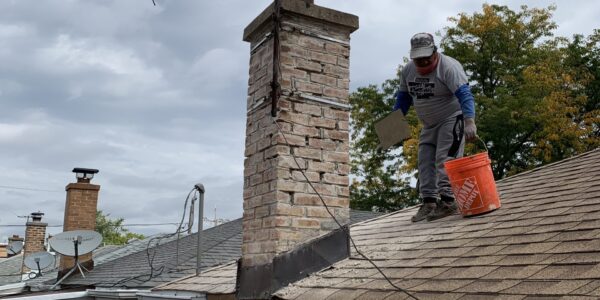
Why Chicago Chimneys Fail Faster Than Anywhere Else
Chicago chimneys operate in one of the most destructive masonry environments in North America. The failure mechanism is not age — it is physics.
Mortar absorbs water. When temperatures drop below freezing, that water expands inside the joints. Each freeze-thaw cycle widens micro fractures, separates aggregate from binder, and eventually converts solid mortar into granular sand.
This process repeats hundreds of times per year. Once joints open, the chimney begins absorbing bulk water instead of shedding it, accelerating deterioration exponentially.
Freeze-thaw expansion, salt exposure, and rapid temperature swings progressively weaken mortar joints and can ultimately compromise structural stability if left untreated.
What Tuckpointing Actually Repairs
Tuckpointing does not repair bricks — it restores the load transfer system between them.
Brick masonry functions as a compression structure. The mortar joints distribute vertical loads and seal the wall against moisture. When mortar erodes, bricks begin moving independently and stress concentrates at corners, crowns, and flashing lines.
During professional tuckpointing, deteriorated mortar is removed and replaced with new mortar to restore integrity and prevent water intrusion.
Without intervention, the next stages are predictable:
Stage 1 — Cracking mortar joints
Stage 2 — Interior moisture infiltration
Stage 3 — Spalling bricks
Stage 4 — Leaning chimney or crown failure
Stage 5 — Structural rebuild
Tuckpointing is the only stage where the chimney can be preserved instead of reconstructed.
Our Chimney Tuckpointing Method
We do not apply surface mortar patches. Chicago masonry requires full-depth restoration.
1. Mortar Analysis & Compatibility Matching
Modern mortar that is too strong will destroy historic brick. We analyze hardness and porosity and formulate a compatible mortar designed to remain sacrificial — meaning the joint wears instead of the brick.
2. Controlled Joint Grinding
All failing mortar is removed to proper depth (typically ¾”–1”) using dust-controlled grinding equipment. Shallow grinding causes premature failure because new mortar cannot bond.
3. Joint Cleaning & Saturation
Joints are washed and pre-dampened so existing brick does not pull water from fresh mortar. Proper curing determines lifespan.
4. Structural Repointing Installation
New mortar is packed in lifts and compressed to eliminate voids. This restores load transfer and seals the chimney.
5. Finish Tooling & Weather Sealing
Joints are tooled to shed water and prevent capillary intrusion — the primary cause of Chicago chimney leaks.
Signs Your Chimney Needs Tuckpointing
Most homeowners wait too long because chimney deterioration starts small but accelerates rapidly.
Early indicators:
Sand or grit collecting at the base of chimney
White staining (efflorescence)
Hairline cracking along mortar lines
Water stains near fireplace
Advanced indicators:
Loose bricks
Interior leaks
Missing mortar gaps
Spalling faces
If mortar joints are failing, water will enter the structure and damage surrounding components.
Tuckpointing vs Chimney Rebuild
Homeowners often believe they need a rebuild when they actually need structural repointing.
Tuckpointing repairs joints.
Rebuilding replaces bricks and structural sections.
When performed early, tuckpointing prevents major structural reconstruction and preserves the existing chimney.
How Long Chimney Tuckpointing Lasts
Properly installed chimney mortar typically lasts 20-30 years depending on exposure and material selection.
Incorrect mortar or shallow repairs can fail within 3-5 years — which is why many homeowners believe tuckpointing “doesn’t work.”
Why Green World Construction
We approach chimney tuckpointing as structural masonry preservation, not patch repair.
Our projects are designed to:
Restore compression strength
Prevent water intrusion
Match historic masonry aesthetics
Withstand Chicago freeze-thaw cycling
Our company specializes in roofing, masonry and chimney restoration throughout the Chicago area.
Schedule a Chimney Inspection
The cost difference between tuckpointing and rebuilding a chimney can be tens of thousands of dollars. The determining factor is timing.
If your mortar is beginning to deteriorate, the chimney can almost always be preserved.
Once bricks begin failing, replacement becomes unavoidable.
Contact Green World Construction for a chimney inspection and structural evaluation.